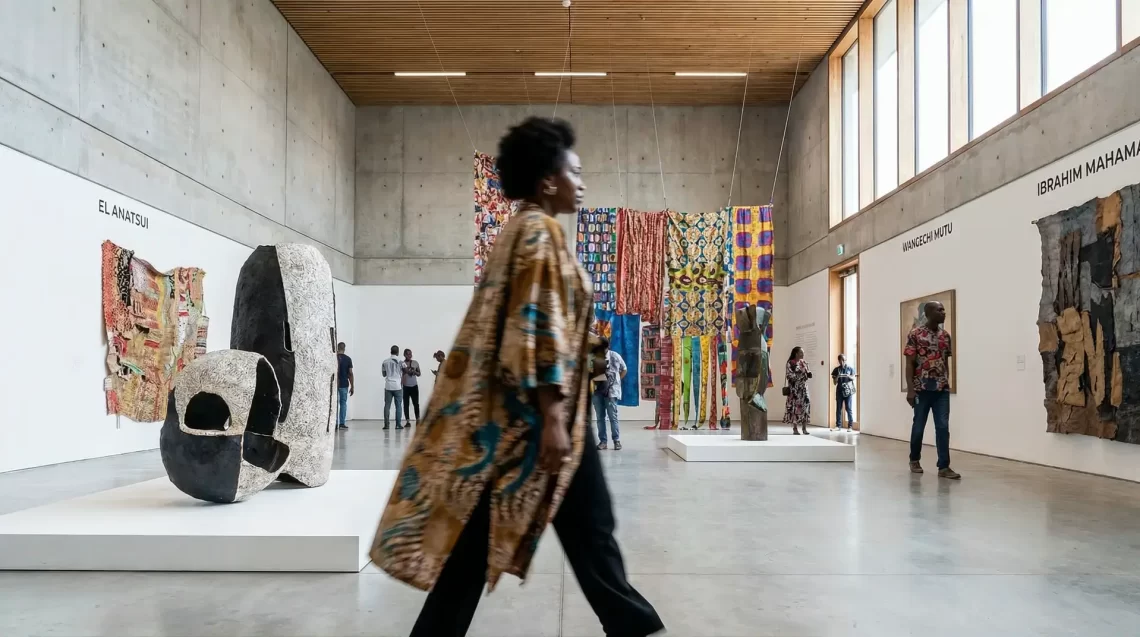
Something significant has been happening in the art world over the past decade — and if you haven’t been paying attention, now is a good time to catch up.
Contemporary African art has gone from a niche conversation among specialists to one of the most dynamic, fast-growing, and genuinely exciting spaces in global culture. We’re talking auction sales that hit $87 million in 2022 alone — and that’s just what moved through the major auction houses, not the galleries, private sales, and events where much of the action takes place.
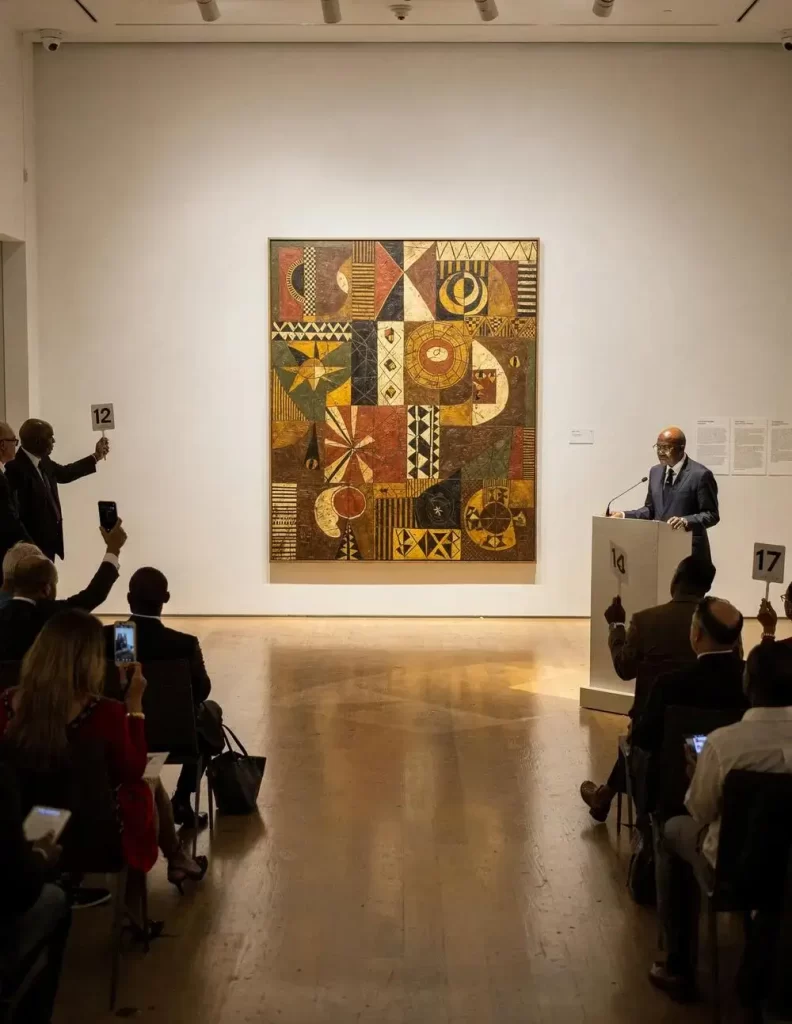
Yes, the market pulled back in 2023 and 2024 after the post-pandemic boom. But here’s the thing: a contraction after explosive growth isn’t a crisis. It’s a market maturing. And by any measure — institutional investment, gallery openings, biennale attendance, international collector interest — the trajectory of contemporary African art is unmistakably upward.
One more thing worth saying before we dive in: this is a space notably driven by women. In 2024, female artists accounted for 52.8% of African art auction sales — a remarkable statistic in an art world that has historically undervalued women’s work everywhere. The current auction record is held by Ethiopian-American artist Julie Mehretu, whose stunning abstract paintings in acrylic and ink sold for $10.7 million. She’s not an outlier. She’s a signal.
So where is all of this happening? Everywhere — but some places more than others. This post is your map.
Interested in the African art space? Our guide to famous African painters is a good place to start — as is our roundup of 21 contemporary African artists changing the game right now.
Jump to:
Where It’s Happening: Five Cities to Know
Contemporary African art doesn’t have a single center. It has several, each with its own character, its own energy, and its own contribution to the larger story.
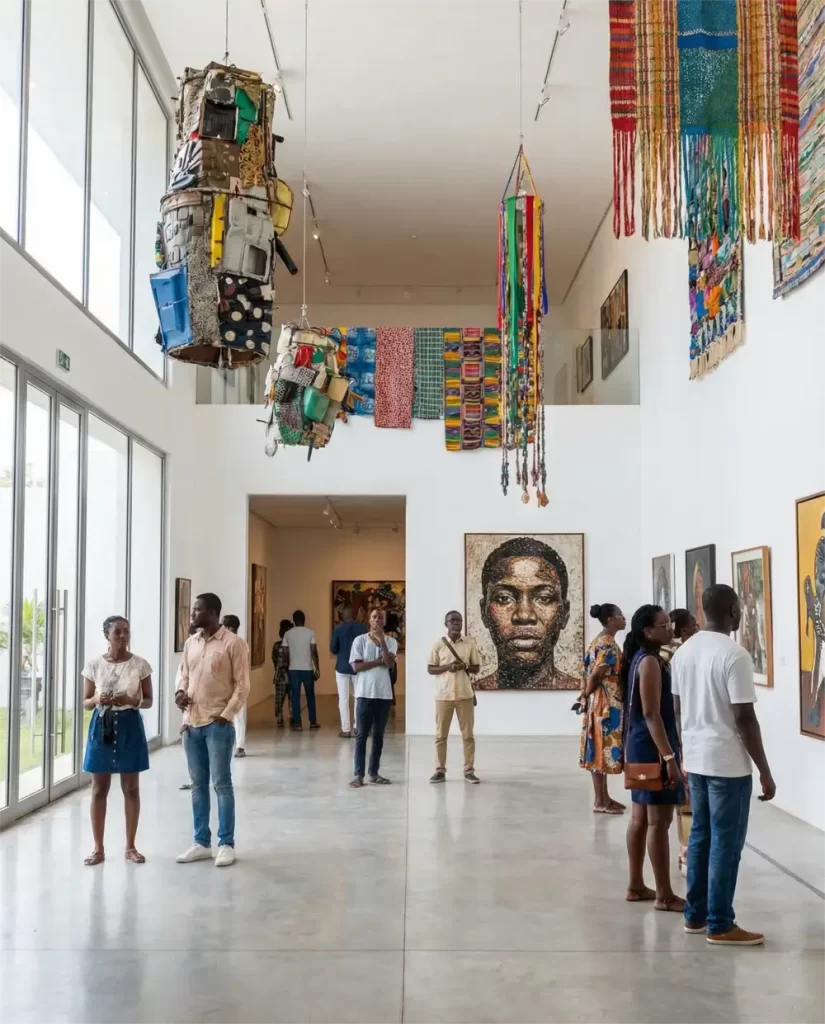
Lagos is the commercial engine — fast-moving, market-driven, entrepreneurial. It’s where galleries push new talent hard and collectors are always circling. The city has produced some of the most internationally recognised African artists of the past decade, and its infrastructure is growing to match that ambition.
Cape Town is the most internationally integrated hub on the continent, anchored by the Zeitz MOCAA — more on that below. If Lagos is where the business happens, Cape Town is where the institution-building is most advanced.
Dakar is the soul of the scene. It’s the biennale city, more conceptual, more rooted in African cultural discourse than in market dynamics. The city has an artistic energy that’s hard to describe until you’ve walked through it.
Nairobi is East Africa’s rising hub, particularly around the East Africa Art Biennale. A region that rarely gets its due in global coverage but is building serious momentum.
Marrakech sits at the gateway between Africa and Europe, and plays that role consciously. The 1-54 art fair uses Marrakech as one of its three global stops precisely because of that positioning.
The 2026 Calendar: Events Worth Planning Your Year Around
Here’s what separates the serious collector or art lover from the casual observer: you follow the calendar. These are the events where contemporary African art is made, debated, sold, and celebrated — and 2026 is as rich as it gets.
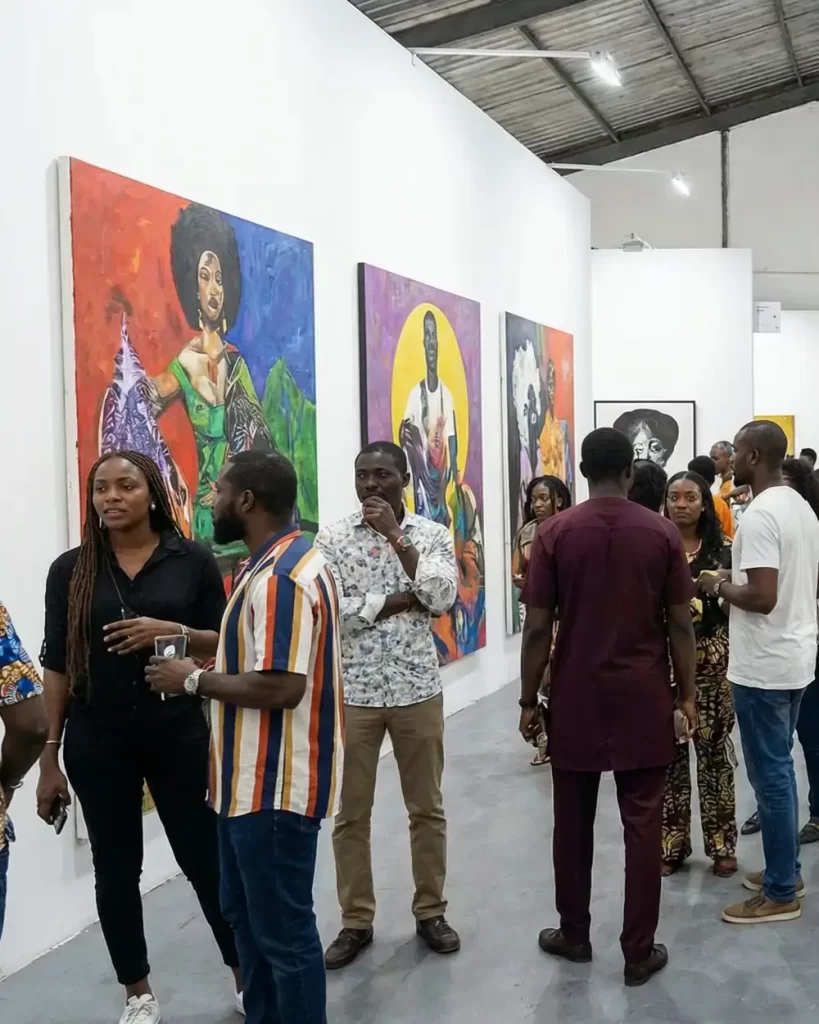
Investec Cape Town Art Fair — February 20–22, 2026
Africa’s largest art fair, and one that has grown into a genuinely world-class event. The 2025 edition welcomed over 30,000 visitors and 10,000 VIPs, with 125 exhibitors showcasing 500 artists from 58 countries. Let those numbers sink in. This isn’t a regional event anymore. The 13th edition ran from February 20 to 22, 2026. More details here.
1-54 Contemporary African Art Fair — New York, May 13–17, 2026
The fair that travels. 1-54 operates simultaneously in New York, London, and Marrakech — which means African art is being presented directly to collectors on three continents. The New York edition runs May 13 to 17, with London following in October and the next Marrakech edition in March 2027. Fair details here.
East Africa Art Biennale (EASTAFAB) — September 15 to November 20, 2026
The 11th edition heads to Nairobi, rotating through cities like Dar es Salaam, Kampala, and Kigali over the years. East Africa has long been underrepresented in the broader conversation about African contemporary art — EASTAFAB is the corrective. Two months of programming across one of the continent’s most dynamic cities.
ART X Lagos — November 5–8, 2026
Nigeria’s premier international art fair, founded in 2016 by Tokini Peterside with a simple but powerful stated mission: “I wanted to bring the world to us.” Ten years in, the 11th edition proves that mission has been accomplished. ART X Lagos is now a fixture on international collectors’ calendars. About the fair.
Dak’Art — Biennale de Dakar — November 19 to December 19, 2026
Africa’s longest-running contemporary art biennale, now in its 16th edition. Dak’Art transforms the entire city of Dakar into an exhibition space — and that’s not hyperbole.
Venues span diverse neighborhoods, official institutions, and what the biennale calls its “OFF” program: hundreds of independent exhibitions in established galleries, improvised spaces, private homes, and street corners. Many visitors will tell you the OFF is more exciting than the official program. An entire month in Dakar in late 2026. Put it in the diary.
Rencontres de Bamako — November 26, 2026 to January 26, 2027
The continent’s most prestigious photography event, now in its 15th edition. Based in Mali’s capital, this biennial explores identity, resilience, and innovation through the lens — and has been doing so with remarkable consistency for three decades. If photography is your medium of choice, this is your pilgrimage. More here.
Other Institutions to Visit Year-Round
The events are the peaks. But the following institutions are where the sustained work of building contemporary African art’s permanent infrastructure is happening — and they’re worth visiting any time you’re in these cities.
Zeitz MOCAA — Cape Town, South Africa
The world’s largest museum of contemporary African art. Housed in a converted grain silo on Cape Town’s V&A Waterfront and redesigned by acclaimed architect Thomas Heatherwick, Zeitz MOCAA is one of those buildings that takes your breath away before you’ve even seen what’s inside. The collection focuses exclusively on art produced in Africa and the African diaspora since 2000. This is the institution that says: contemporary African art belongs in a dedicated space, not as a footnote in a general contemporary museum.
MACAAL — Marrakech, Morocco
The Museum of African Contemporary Art Al Maaden. North Africa’s anchor institution for the contemporary art conversation — and a reminder that “African art” encompasses an enormous geographic and cultural range, from the Maghreb to the Cape.
MOWAA — Benin City, Benin
The Museum of West African Art, designed by David Adjaye — one of the world’s most celebrated architects, and a man who brings considerable intentionality to what African cultural institutions should look and feel like. MOWAA positions itself at the intersection of traditional masterpieces and contemporary works, refusing the false choice between heritage and innovation. A major new arrival to the institutional landscape.
Key Galleries in Lagos, Nigeria
For those who want to engage with the primary market — where artists and collectors meet directly — Lagos has a remarkable concentration of serious galleries. Rele, kó, Ogirikan Art Gallery, and Nike Art Gallery are all actively shaping the contemporary conversation and supporting the African artists who are rewriting the rules.
My Personal Bonus
If you’re in Dakar, don’t miss Loman Art House — a gallery-café-residency hybrid in the Mamelles district that is, quite simply, one of the most moving spaces I’ve walked into anywhere in the world.
The Global Moment: Contemporary African Art Beyond the Continent
Here’s the bigger picture, and it’s worth saying clearly: contemporary African art is no longer just reshaping African cities. It’s reshaping the global art world.
The evidence is everywhere. The 1-54 fair operates on three continents. MoMA in New York is currently running Ideas of Africa: Portraiture and Political Imagination (through July 2026) — placing African and diasporic artists at the center of contemporary art history. African participation at the Venice Biennale continues to grow, with South Africa confirming participation following an open curatorial process. Major auction houses have made dedicated African art departments a permanent fixture, and the cumulative result — over $100 million in dedicated African art sales at Sotheby’s, Christie’s, and Bonhams since 2017 — gives a glimpse of what’s to come.
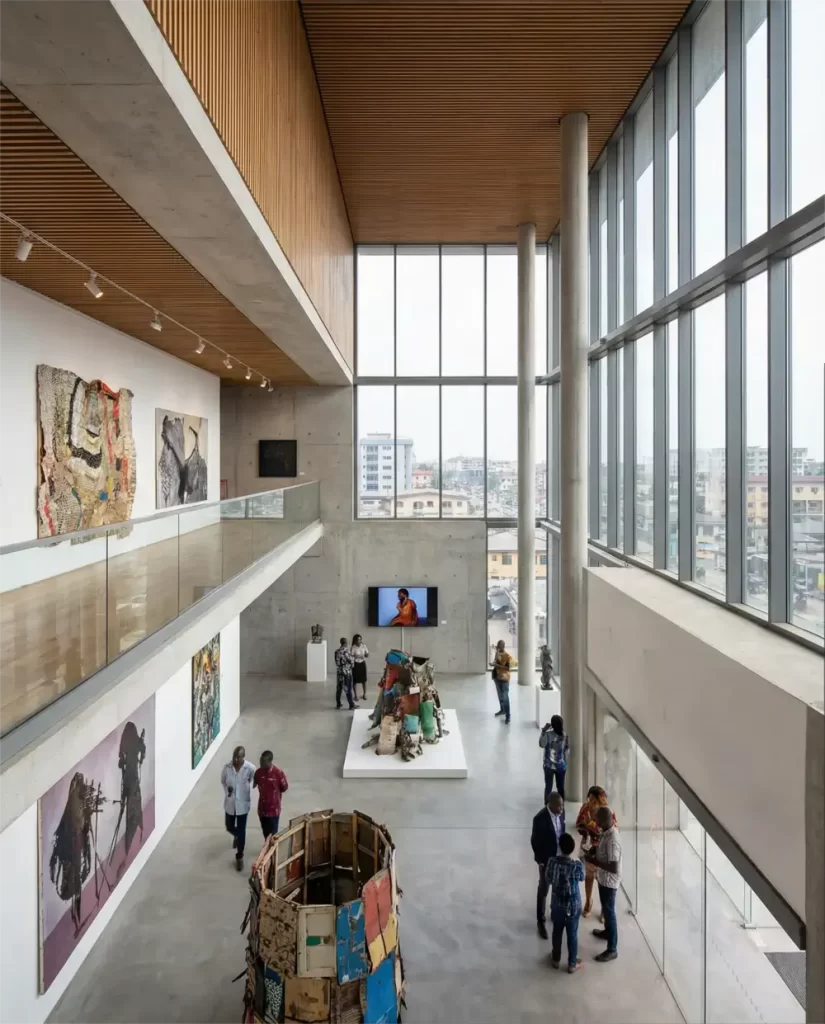
This all points to something that feels genuinely new: infrastructure. For years, the talent was never the question. African artists have been producing world-class work for decades, much of it without the institutional support or market access that their peers in New York or London took for granted. That gap is closing — through biennales and fairs, through new museums, through galleries that have done the slow, unglamorous work of building collector relationships and critical discourse over years.
The modern African art foundations were laid over generations of extraordinary artists. The contemporary chapter is being written right now, and the writing is happening across five time zones, in a dozen languages, in converted grain silos and photography biennales in Bamako.
The only question is whether you’re paying attention.
Read next: How Modern African Art and Design Redefine Exciting Spaces