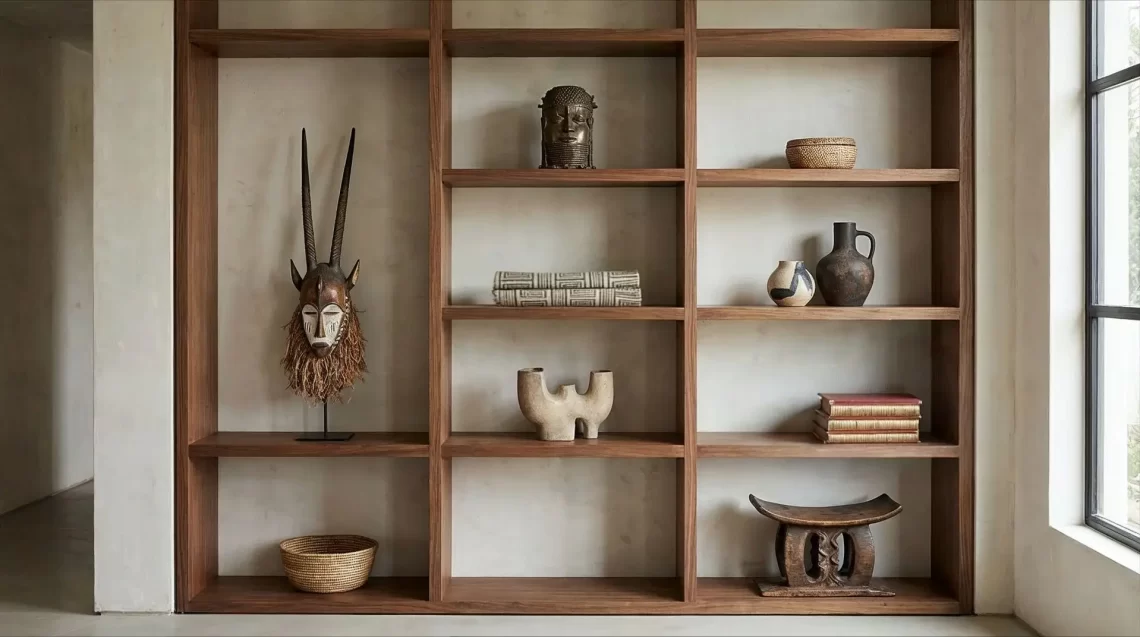
I didn’t decide to start a heritage collection. I just kept buying things — coffee table books, small African objects picked up during travels — and one day I looked around my shelves and thought: oh. This is something.
I believe this is exactly how it’s supposed to go. A collection shouldn’t be started, it should be born. And curating one that will mean something to you over decades takes a specific kind of patience. Here’s what building one has taught me.
Browse:
1. The Start Should Be an Accident
What nobody tells you about collecting is that you should never start with the intention of collecting. The intention poisons it. It turns something that should feel organic and intimate into you seeking to accumulate things.
The way it actually works is slower, and better. You find a piece here. You bring something back from a trip. Someone gifts you something that turns out to be exactly right. And then one day, without planning it, you look at what you have and you see a pattern. A through-line.
For me, that pattern is coffee table books on one end and small decorative objects on the other. They live together on my shelves — the one place in my apartment where they can both be seen and also sit completely undisturbed. A book propping up a small carved piece. An object anchoring a stack of photography volumes. They pair in a way I could never have designed in advance, because the pairing only works when both things came from the same instinct.
What are you inherently drawn to? What keeps appearing in your life without you summoning it? Don’t seek the answer. Let it surface. When it does, you’ll know you’re on your way.
2. The Journey is the Point (Yes, Really)
The process of building a collection should be slow. Almost frustratingly slow. Every cliché about the journey being the point turns out to be completely true here.
Places matter
The best pieces don’t tend to come from the first place you think to look. They come from wandering the right neighbourhood at the right time, or from something landing in your hands completely by chance.
Most of my decorative objects were found exactly this way: stumbled upon, not searched for. I wasn’t on a hunt. I was just somewhere — a market, a city I was moving through — and I spotted something. That unplanned encounter is part of what makes the piece feel alive in your home. You know the exact afternoon it came into your life.
One of my favourite pieces in my collection isn’t even something I found myself. My grandmother brought back a beautiful bracelet from South Africa, but what stopped me was the box it came in. Small, white, in a marble-like material, hand-painted with blue and gold floral details. Simply delightful. The bracelet now lives in another box, and this box lives on my shelf. It has become, without any intention, one of the loveliest things I own.
People matter more
The curators you develop a relationship with over time. The artisans you meet during travels who tell you something about their craft you’ll never forget. The like-minded collectors who share a page of their book with you. People are the beating heart of collecting — and the relationships you build along the way are often as meaningful as the objects themselves.
3. The Selection Relies on 3 Pillars
Finally, the exciting part. The reward at the end of the journey. The moment the piece is in front of you and you have to decide.
So how do you know when something is the one? To me, it comes down to three things.
It has to be a seasoned choice
Don’t rush in before you know yourself well enough to know what you’ll still love in five years. Time is the most useful tool you have. Browse, sit with things, come back to them. The pieces that are truly for you will keep coming back.
Another thing I’ve come to realise is that being genuinely knowledgeable about what you collect changes everything. I have a deep interest in African craftsmanship, and the research gives you a foundation. It means that when a piece appears in front of you, you already know its backstory. You can recognise the craft, place its origin, understand what it took to make it. The research doesn’t direct the finding, but it enriches it.
You May Also Like: Authentic African Artifacts: Everything You Need to Know
You have to feel something immediately, and durably
Not every piece needs to stop you dead in your tracks, but something needs to happen. A pull, a recognition, a quiet yes — and that feeling has to hold. The more you look at it, the more it should draw you in. If there’s any doubt, it’s not the one. Move on without grief.
For me, I never choose a coffee table book out of aesthetics alone. A beautiful spine is not enough. The book has to move me either through its cover — like Tropical Modernism, which caught my eye the second I saw it — or through its content, like the African Decor Edit, which speaks directly to crafts I care about.
Third, it has to make financial sense
This one is unglamorous but important. I don’t believe in ruining yourself over a single piece, no matter how much it moves you in the moment. Love is not a justification for every price tag. If it’s out of range, it’s simply not meant to be right now.
And here’s the thing: the most beautiful stories in any collection are the pieces that came back. The object you couldn’t afford the first time, that found its way to you again at the right time. Those are the pieces with the best narratives. Don’t chase them, let them return.
A collection built slowly, intuitively, with knowledge behind the instinct beats an edited home every time. It becomes an archive of your life, with each piece being a memory of where you were and how you found it.
That’s what makes a heritage collection different from a vanity one. Identity, purpose, and stories you’ll remember.