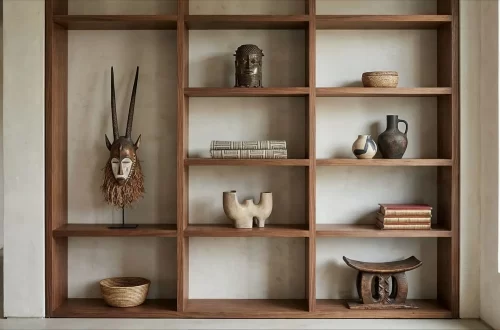
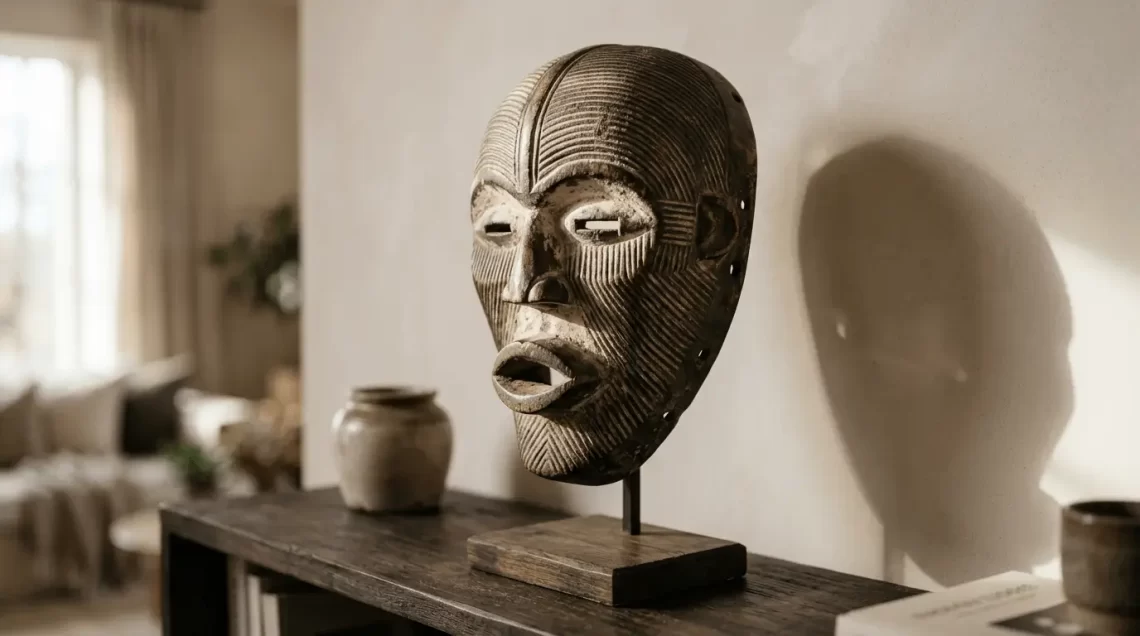
There is a mask in the foyer of the house where I grew up. My mother bought it, the way mothers collect things without explaining why. It is a decorative Songye-style mask. Not the kind of piece a museum would fight over but the kind sold to travelers who want something to remember a trip by.
I walked past it for twenty years without a single thought. Then a couple of years ago, I learned what a real Songye mask is. And I have not walked past it the same way since.
What the Kifwebe Mask Allowed Me to Grasp
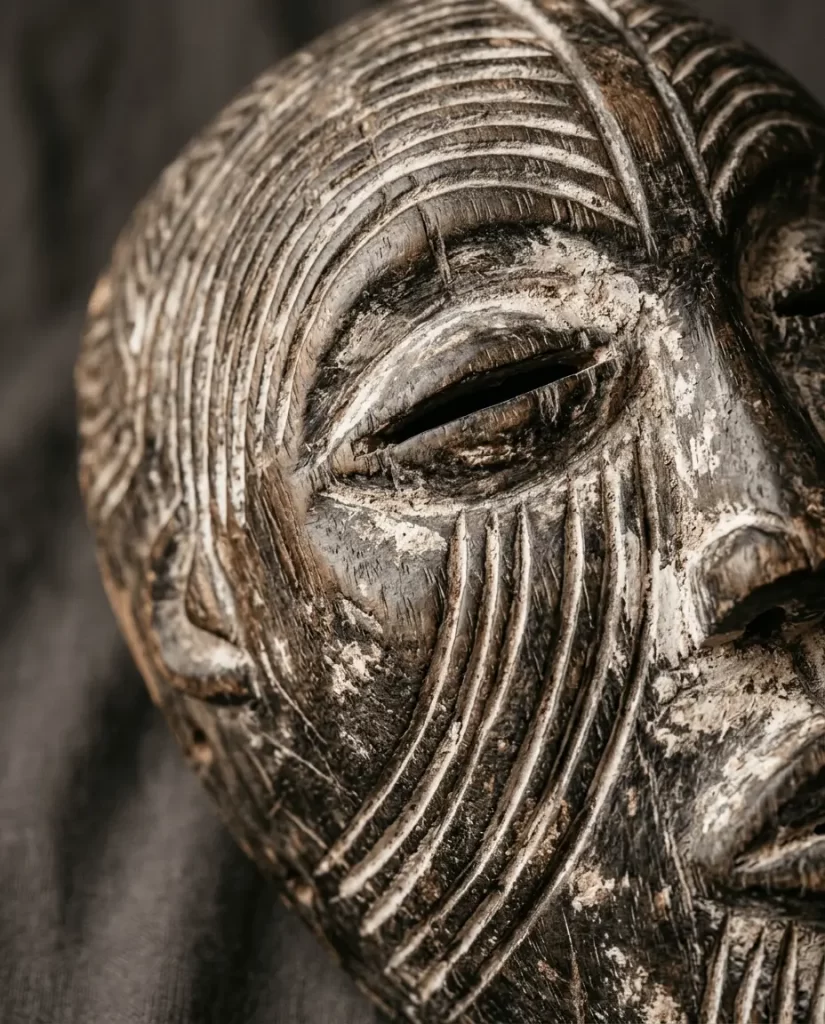
The Songye people of the Democratic Republic of Congo carve what are called Kifwebe masks. They draw bold lines across the face like current through a wire.
Male masks wear tall crests and bright color. They used to be worn by men who kept order in the community. Female masks are quieter, rounder, rubbed with white kaolin clay that fades with time and use, leaving the wood beneath a little more exposed after every ceremony.
You May Also Like: Traditional African Masks: 7 Icons That Steal the Spotlight
Although it is art, a Kifwebe mask was never made to be hung as a piece of art. It was made to be worn. While it was on someone’s face, it exuded an inexplicable kind of authority, carried by someone who had agreed to uphold something bigger than itself for the length of a ceremony.
Even in my wildest thoughts, I could have never imagined this level of depth.
A Different Language for Every People
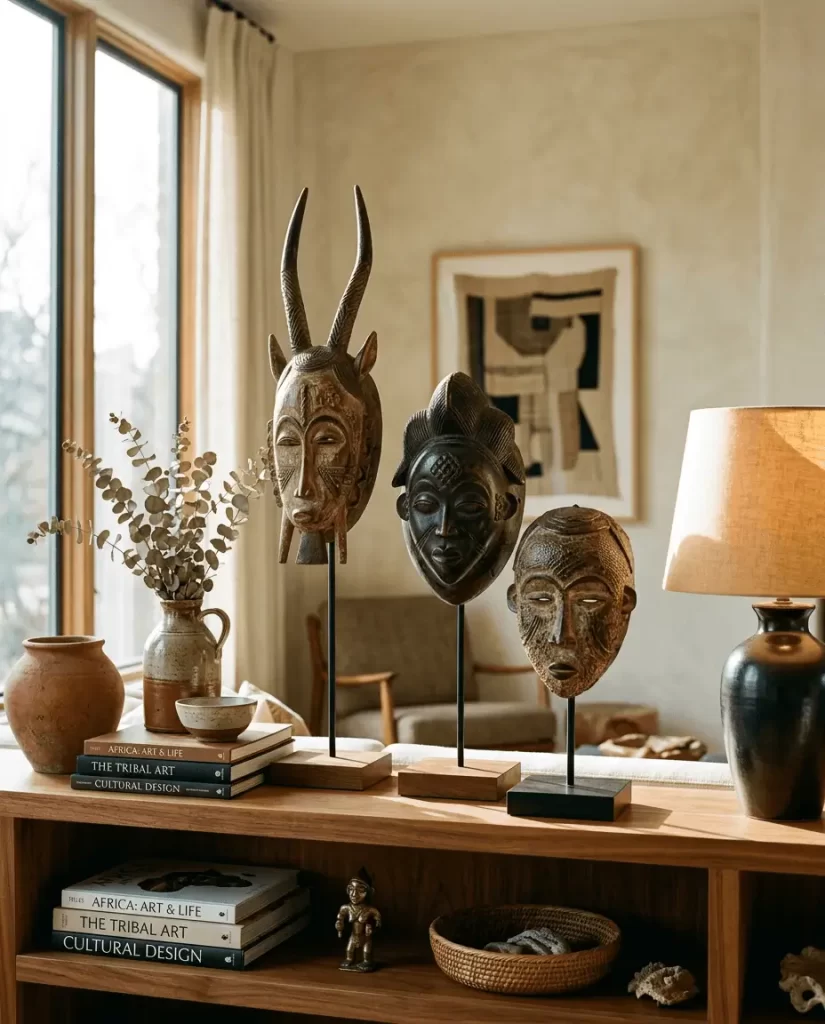
Across the continent, this repeats in a wide range of forms. The Fang Ngil mask from Gabon is pale and elongated. It was worn by a men’s society that used it to expose wrongdoing and push back against those who threatened the peace of the village. The Dan mask from Liberia was carved only after its shape arrived in a dream. Its people believe the mask is a forest spirit, a gle, choosing how it wants to be seen before a carver touches wood.
None of these masks were made to be beautiful objects. I might even argue that some are not beautiful in the conventional sense. But beauty happened when a community gave life to their deepest beliefs through this face.
I think about this every time I see masks being called “tribal”. As if the years of apprenticeship, the dreamed visions, and what they embody, could be flattened into one lazy adjective. A Songye mask and a Dan mask have as much in common as a Gothic cathedral and a Shinto shrine. Different peoples, and completely different meanings.
You May Also Like: 3 Authentic West African Masks: Your Guide to Sacred Art
The Moment the You Understand the Object
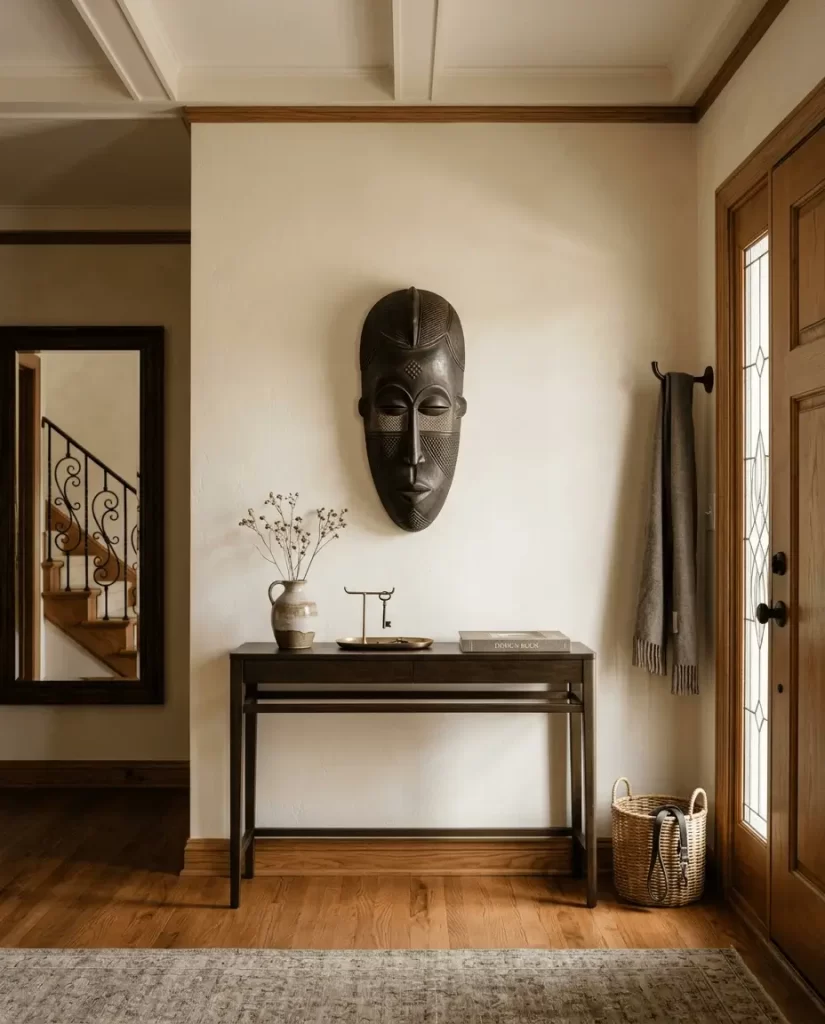
Ask anyone from a community where masking traditions are still alive, and they will tell you the wearer becomes something else. Not “represents.” Becomes. The person underneath the mask disappears and something older steps forward in their place.
I did not grow up inside that tradition and I cannot claim I have felt what someone raised in a Dan or Songye community has felt. But I understand now that what I’m able to grasp is only the edge of something larger.
That is the energy sitting in every authentic mask that made its way into someone’s living room. Most of them will never be worn again. But the intention that shaped them does not evaporate because the ceremony ended.
You May Also Like: Authentic African Artifacts: Everything You Need to Know
What I Would Tell My Mother Now
If I could go back and ask her why she chose that particular mask, I do not think she would have an answer rooted in Kifwebe symbolism. She probably liked how it looked, and that is good enough of a reason. Most people who bring a mask into their home are not African historians, and they should not have to become one to be permitted a piece of African art on their wall.
But I would want her to know what the shape she chose represented, and how it was used before it graced our wall.
You May Also Like: How to Build a Heritage Collection
I still love the mask in that foyer. I love it more now, because I finally understand what it is pointing to, even in the distance.
I do not think that feeling is nostalgia. I think it is the smallest possible echo of what the mask was built to hold in the first place, reaching me generations and an ocean away from where it was carved.